Every Time You Ask to Use the Bathroom, Your School Is Teaching You Something About Power
The Rule Nobody Questions
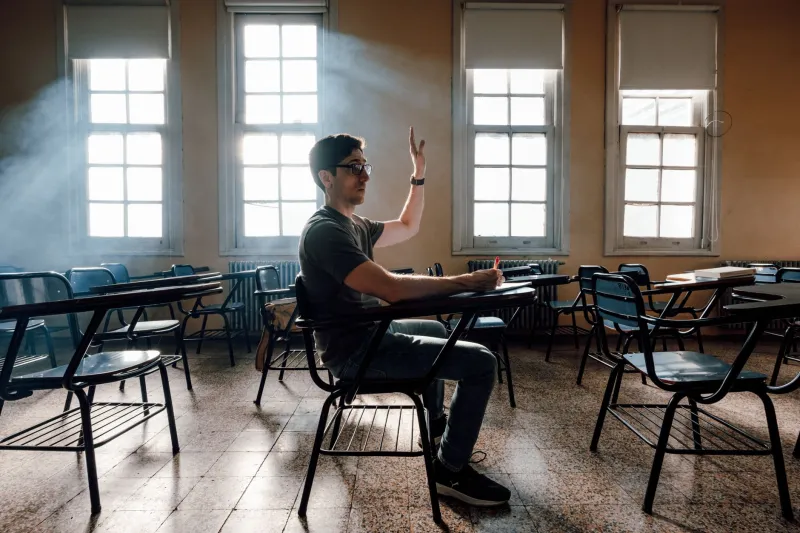
There is a ritual so deeply embedded in the American school day that most students accept it without a second thought: raising your hand, waiting for eye contact, and asking an adult for permission to use the restroom. It happens dozens of times a week across millions of classrooms. It is so ordinary that it barely registers as a policy at all.
But consider what is actually happening in that moment. A student—a developing person with full biological autonomy—is required to interrupt their own bodily awareness, seek approval from an authority figure, accept or be denied that approval, and carry a physical token proving they have earned the right to leave. In many schools across the United States, that token comes in the form of a hall pass: a laminated card, a wooden block, or a lanyard. In others, there are formal systems limiting the number of bathroom trips permitted per semester, logged digitally and tracked against a student's record.
These are not minor administrative details. They are, whether intentionally or not, lessons in how institutions expect human beings to manage themselves.
What the Research Suggests About Permission-Seeking
Psychologists who study behavioral conditioning have long documented how repeated experiences shape long-term attitudes toward authority. When a behavior—like asking permission before meeting a physical need—is practiced hundreds of times over twelve years of schooling, it does not simply disappear upon graduation. It becomes internalized. It becomes the baseline expectation for how institutions operate.
This is particularly significant because bathroom restrictions do not apply equally to everyone in the building. Teachers do not ask permission to step out. Administrators move freely. The permission requirement is structural and directional: it flows downward, from authority to those with less of it. Students absorb this asymmetry not as a conscious lesson, but as ambient reality.
What they learn, quietly and through repetition, is that their body's needs are subordinate to the institution's schedule. That productivity—or the appearance of it—takes precedence over physical comfort. That the appropriate response to having a need is to request, justify, and wait.
The Workplace Parallel Is Not Subtle
For students who eventually enter hourly or shift-based work environments—warehouses, retail, call centers, fast food—the transition from school bathroom policies to workplace bathroom monitoring can feel seamless. This is not an accident, and it is not entirely benign.
In 2023, reporting from multiple labor organizations highlighted that some large employers actively track bathroom breaks, flag employees who take too many, and use productivity software to monitor time away from workstations. These practices have faced legal scrutiny in several states. But for workers who grew up in schools where bathroom access was rationed and logged, the emotional response to such policies may be strikingly muted. The discomfort of asking permission—and the anxiety of being denied—is already familiar.
This is the quiet function of what some education researchers call the "hidden curriculum": the set of norms, hierarchies, and behavioral expectations that schools transmit not through lesson plans, but through the lived experience of institutional life. Bathroom policies are a particularly vivid example because they operate at the intersection of the personal and the procedural. They are intimate. And they are enforced daily.
What Educators Say—and What They Don't
Many teachers are quick to explain the practical logic behind bathroom restrictions. Unsupervised hallways present safety concerns. Students who leave class frequently may fall behind. Some students, given unrestricted access, will use bathroom trips as a way to avoid instruction or socialize outside the classroom.
These are not unreasonable observations. But they raise a separate question: why is the default response to these concerns a system of restriction and surveillance rather than one built on trust and graduated responsibility?
Some schools have experimented with alternatives. A growing number of educators have moved toward open bathroom policies in which students sign out quietly without requiring explicit verbal permission. Others have worked with school counselors to identify students who frequently leave class as a potential indicator of anxiety, bullying, or other issues requiring support—rather than treating the behavior as a discipline problem.
The difference in framing matters enormously. One approach treats the student as a subject to be managed. The other treats them as a person whose behavior carries meaning worth understanding.
The Dignity Question Schools Are Avoiding
There is a dimension to bathroom policies that most school handbooks do not address directly: dignity. Asking a teenager to raise their hand in front of thirty peers and announce a biological need is, for many students, a source of genuine humiliation. For students managing health conditions—irritable bowel syndrome, urinary tract infections, menstrual disorders, anxiety-related physical symptoms—the experience can range from uncomfortable to genuinely distressing.
For students from lower-income households, who are statistically more likely to attend under-resourced schools with stricter behavioral controls, the cumulative effect of these small indignities compounds over time. Research on adverse school experiences consistently finds that environments characterized by high control and low trust are associated with reduced engagement, higher dropout rates, and lasting negative associations with institutional authority.
The students most affected by punitive bathroom policies are rarely the ones whose voices shape school policy discussions.
What You Can Actually Do About This
If you are a student navigating a restrictive bathroom policy, there are practical steps worth knowing. First, your school's student handbook—which Urusan Sekolah has covered in previous articles—should outline the specific terms of any bathroom restriction policy. Understanding the written rule is the first step to knowing whether it is being applied appropriately or excessively.
If you have a documented medical condition that affects your need for bathroom access, you may be entitled to accommodations under Section 504 of the Rehabilitation Act or the Individuals with Disabilities Education Act. A conversation with your school counselor or a parent or guardian can initiate that process.
More broadly, student government organizations and parent-teacher associations are legitimate channels for raising concerns about policies that affect student wellbeing. Schools are not monolithic—they are shaped by the people within them, and policy change at the building level is more achievable than most students realize.
The Lesson Underneath the Policy
The purpose of examining bathroom policies is not to argue that schools should have no structure or that every restriction is malicious. It is to develop the habit of asking what any institutional rule is actually teaching—not just what it says on the surface.
When a school conditions students to seek permission for their most basic physical needs, it is transmitting a message about the relationship between individuals and institutions. That message may serve certain labor markets. It may not serve students who hope to advocate for themselves, negotiate their working conditions, or build careers in environments that reward self-direction.
The most important skill you can take from noticing this is the ability to see the curriculum beneath the curriculum—to recognize when a policy is shaping your behavior and to decide, consciously, how much of that shaping you are willing to accept.