How the Walls, Windows, and Hallways of Your School Are Already Teaching You Something
Walk into any American high school and you will likely notice the same general features: fluorescent-lit corridors, rows of lockers, a cafeteria that doubles as an auditorium, and classrooms arranged in predictable grids. Most students move through these spaces on autopilot, treating the building as nothing more than a container for their education. But researchers, architects, and education specialists increasingly agree on something that might surprise you: the physical design of your school is not neutral. It is, in fact, one of the most persistent and underappreciated influences on your academic performance, social behavior, and mental well-being.
This is what some educators call the invisible curriculum — the lessons your environment teaches without ever appearing on a syllabus.
Light Is Not Just About Visibility
One of the most thoroughly studied aspects of school design is natural lighting, and the findings are striking. A landmark study conducted across multiple school districts in the United States found that students in classrooms with greater access to daylight performed measurably better on standardized math and reading assessments compared to peers seated in artificially lit rooms. The difference was not marginal — in some cohorts, the improvement reached double digits in percentage terms.
The science behind this is rooted in human biology. Natural light regulates circadian rhythms, which govern sleep patterns and alertness cycles. When students spend hours under harsh fluorescent bulbs — the default in many aging American school buildings — their bodies receive inconsistent signals about time of day, which can lead to fatigue, reduced concentration, and even elevated stress hormones.
If your classroom offers windows, consider where you sit. Positioning yourself closer to natural light sources, without direct glare on your work surface, is a small but meaningful adjustment. If your school environment is predominantly artificial, advocate for breaks that take you outside, even briefly. Exposure to natural light during passing periods or lunch can partially compensate for what your classroom lacks.
The Geography of Your Classroom Matters More Than Your Seat Number
Beyond lighting, the internal arrangement of a classroom carries significant behavioral implications. Traditional row-based seating, which remains common in American secondary schools, tends to concentrate teacher attention toward the front and center of the room. Students seated in what researchers call the "action zone" — roughly a T-shaped area extending down the middle column and across the front rows — receive more direct eye contact, more questions, and more instructional interaction.
This is not a matter of favoritism. It is a structural consequence of classroom geometry. Teachers naturally direct their gaze and movement toward the path of least physical resistance, and the layout of most standard classrooms creates that path right through the center.
For students who feel disconnected or disengaged, understanding this dynamic is empowering. Deliberately choosing a seat within or near the action zone — even in a class you find challenging — can increase your participation simply by placing you within the natural flow of instructional attention. Conversely, students who prefer independent processing may benefit from edge positions where ambient noise is lower and distractions are fewer.
Hallways Are Social Architecture
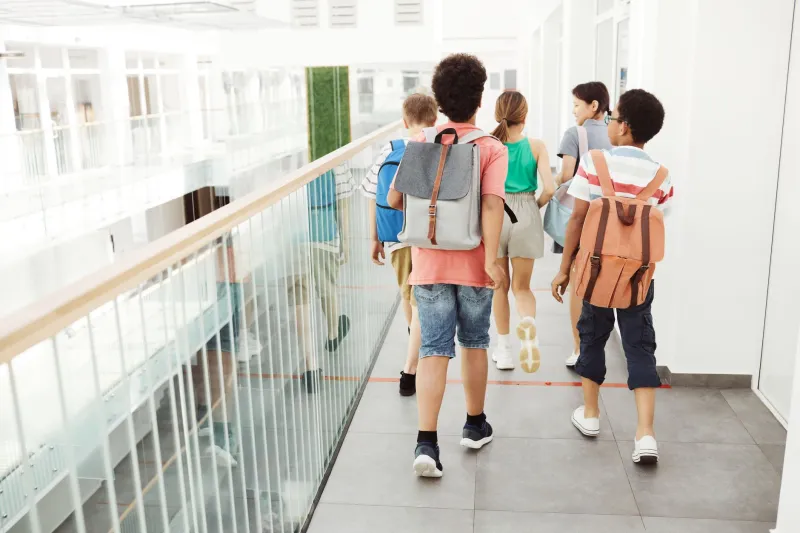
The design of hallways and common spaces in a school does not merely facilitate movement — it engineers social interaction, sometimes in ways that create unintended consequences. Wide, open corridors with natural gathering points tend to encourage informal peer connection, which research links to a stronger sense of belonging and reduced rates of social anxiety among adolescents.
Narrow, congested hallways, by contrast, can elevate stress during transition periods. When students are physically compressed into tight spaces for several minutes between every class period, the cumulative effect across a school day can be surprisingly taxing. Studies in environmental psychology suggest that chronic crowding — even in short bursts — activates mild stress responses that carry over into the classroom.
If your school's hallways feel overwhelming during passing periods, consider adjusting your timing when possible. Leaving class a few moments early (with instructor permission) or taking alternate routes can meaningfully reduce your daily exposure to peak-traffic stress. It is a minor logistical choice with a real physiological payoff.
The Cafeteria as a Social Ecosystem
Few spaces in an American school carry more social weight than the cafeteria. Its design — the placement of tables, the flow from serving lines to seating areas, the presence or absence of acoustic barriers — determines how social hierarchies form and how accessible various peer groups feel to one another.
Open, flexible cafeteria layouts with varied seating options (round tables, long communal benches, smaller two-person arrangements) tend to produce more fluid social mixing. Fixed, uniform seating arrangements, particularly those organized in rigid rows, can inadvertently reinforce social stratification by limiting natural movement and spontaneous interaction.
For students navigating complex social terrain — which is to say, essentially every student in high school — being conscious of how the cafeteria environment shapes behavior can be genuinely useful. Choosing to sit in transitional zones between established social clusters, for instance, can organically expand your social network without the awkwardness of a forced introduction.
Noise, Acoustics, and the Hidden Tax on Your Concentration
Acoustics represent one of the most overlooked dimensions of school design. The American National Standards Institute has published guidelines recommending that background noise in classrooms not exceed 35 decibels and that reverberation times remain below 0.6 seconds. The reality in many older American school buildings falls well short of these standards.
Excessive noise — whether from HVAC systems, outdoor traffic, adjacent classrooms, or hard-surfaced walls that amplify echo — imposes a measurable cognitive load on students. When your brain is partially occupied with filtering unwanted sound, the mental resources available for comprehension and retention are reduced. This effect is particularly pronounced for students with hearing differences, language processing challenges, or attention-related learning profiles.
If you find yourself consistently fatigued or distracted in a particular classroom, the acoustics of that space may be a contributing factor rather than a personal failure of focus. Using noise-dampening tools like earplugs or noise-canceling headphones during independent work (where permitted) can partially offset a poor acoustic environment.
Taking Ownership of What You Cannot Change
Not every student attends a school with optimal architecture, and most students have little power to redesign their building. But awareness itself is a form of agency. When you understand that your environment is influencing you, you move from being a passive occupant of space to an informed navigator of it.
Advocating for environmental improvements — through student government, parent-teacher organizations, or direct communication with school administrators — is also a legitimate and often underutilized pathway. Schools that have successfully secured funding for lighting upgrades, acoustic panels, or flexible furniture arrangements frequently point to organized student and family advocacy as a catalyst.
Your school building is not just a backdrop to your education. It is, in a very real sense, part of the curriculum itself. The more deliberately you engage with it, the more of its invisible lessons you can turn to your advantage.